I've got a review of Tom Lloyd's debut fantasy novel over at Book Spot Central. Have a look.

I've got a review of Tom Lloyd's debut fantasy novel over at Book Spot Central. Have a look.
Dave Arneson, co-creator of Dungeons and Dragons, died earlier this month at the age of 61. A lot of things I said when Gary Gygax died are fitting here as well.
I know far more about Dungeons and Dragons than is reasonable for someone who has never actually played it, save through computer game adaptations like Baldur’s Gate and Planescape: Torment. Tabletop roleplaying games aren’t my thing; I’m too shy and too uncomfortable in groups for it. (Yes, that’s right: I’m too nerdy to play Dungeons and Dragons. God have mercy on me.) As far as I can recall, my first exposure to role-playing games was in the mid to late 80’s, when I would hang out with some older kids on my block who played it.
Arneson’s legacy first seriously touched my life in 1989 or 1990, though I wouldn’t realize it until years later. I was a video game fan, and Nintendo Power magazine was advertising a promotion in which every subscription came with a free copy of a game called Dragon Warrior. (This was when they still insisted on calling games “GamePaks,” which stuck me as very silly even at the age of nine.) I’m not sure how it made financial sense to give away a $40 game to sell $15 magazine subscriptions, but apparently it did. I didn’t know what Dragon Warrior was, but my greedy, calculating young heart couldn’t say no to a deal like that. I mailed in my $15, and a few weeks later the game and my first issue of the magazine arrived.
I had never played anything like it before. Fighting enemies was turn-based. Everything seemed to revolve around numbers- character stats, enemy stats, weapon and armor attributes, calculating what to spend your scarce money on to give you a better chance of surviving. My friends were alternately baffled and bored to tears by it.
It was the greatest game I had ever played.
I had (and have) problems with fine motor control. I liked video games, but I was all but hopeless at most of them. Suddenly, there was a game that did not require reflexes and dexterity I didn’t have, and actually favored my preference for strategy and careful planning. A short while later, I discovered the first Final Fantasy for the NES as well, and I realized I had found my gaming niche. RPGs and strategy games have been my video games of choice ever since.
That first Dragon Warrior seems a bit creaky now, of course. The combat was very simplistic, and the story was scarcely more involved than Super Mario Brothers. But when I was a little kid, it was magic. That game opened up whole imaginative worlds for me, and did so in a time when the real world was not at all a good place.
Dragon Warrior was largely based on previous computer role-playing games like Wizardry and Ultima, which were based on still older games, which were based on the original tabletop Dungeons and Dragons. So, there’s a direct line of descent from Dave Arneson to many of my favorite games today, and I owe him a great deal. Rest in peace.
This should have been posted a while ago, but my usual sloth, combined with a savage and unprovoked squirrel attack on my telephone cables, has delayed me in getting it online. Imagine you’re reading this three weeks ago and it’ll probably be more interesting.
As most people know by now, the Sci Fi Channel has now changed its name to the “SyFy Channel.” There’s really nothing unkind I can say about the name “SyFy” itself that would be more damning than just reproducing it accurately. It’s not unknown for a TV station to radically change its identity while trying to keep some vestige of the name, as when TNN changed from the country music-focused “The Nashville Network” to the action/testosterone-themed “The National Network.” (Which then became Spike, which is both less generic and more appropriately phallic and bellicose-sounding.) Thus, I’m not surprised that they went with a name that maintains a tie to the old one, though you’d think with the amount of money TV networks spend on consulting firms and focus groups they could have come up with something that didn’t sound like a government agency from a David Weber novel.
I don’t even know what their new slogan, “Imagine Greater,” is supposed to mean. It sounds like something that Babelfish has translated from English to Japanese and back again two or three times.
I often get annoyed at this sort of attempt to hide from the Nerd Cooties stigma, but this seems entirely appropriate to me, given how much of the channel seems to be devoted to monster movies, schlock horror, pro wrestling, and reality shows with washed up quasi-celebrities who didn’t quite have the Q factor to hang out with Corey Feldman and Chyna on The Surreal Life. Really, ditching the “Sci Fi” is just a simple acknowledgment of reality. (In that same spirit of accuracy, perhaps “SciFi Channel Original Movie” could be changed to “Not Even Good Enough for Direct-to-Video Theatre.") So, no big loss.
 In the short time since its creation, Solaris Books has really impressed me, both with their authors and with their Solaris Book of New Science Fiction anthology series. It was through the latter that I first became aware of English science fiction author Eric Brown. Necropath
Bengal Station is a huge spaceport in the sea between India and Burma, the entry point to Earth for the faster-than-light ships linking Earth to her colonies, and to alien civilizations beyond. Its tremendous volume is home to millions of people, ranging from the richest to the poorest. Jeff Vaughan is a telepath employed at the station, using his powers to help inspect incoming ships. He is a tormented man, plagued by his memories of the past, dependent on drugs to help him shut out the endless roar of other people’s thoughts, and utterly without hope.
Strange events are taking place at Bengel Station. Mysterious shipments are arriving from offworld, shipments Vaughn’s mind-shielded boss has forbidden him to inspect. A series of men involved in space exploration in their younger days are mysteriously murdered. A bizarre cult with origins beyond Earth is growing on the station, offering a mind-altering “communion” and promising to make all people one with their God.
Vaughn’s search for the truth behind these events takes him through the depths of Bengal Station, and will eventually lead him from Earth to one of humanity’s new settlements among the stars. He faces corruption and betrayal among his colleagues, a mysterious figure hell-bent on hunting him down and killing him, and his own fear and despair accumulated from a past spent exposed to things no one should see. Finally, he will face the force behind the disturbing events on Bengal Station- something far more horrible than a mere criminal conspiracy.
I liked Necropath
While Necropath is largely a thriller/mystery story, it has a strong element of horror, and had a number of elements that made me think of H.P. Lovecraft- bizarre and cruelly uncaring intelligences, communities that conceal horrifying secrets, local people with stories of incomprehensible horrors, and knowledge so disturbing that brushing up against it is psychologically damaging. Parts of the book are quite creepy, and the buildup to Vaughn’s discovery of the truth is effectively chilling. I liked the way the horror, mystery, and science fiction elements of the book mesh. The horrific elements are not merely grafted onto a science fiction base- rather, they are directly integrated with the science fiction and would not be possible outside that context.
I liked the book’s use of the idea of telepathy- some people have a natural affinity for it, but artificial augmentation is necessary to make the potential useful. Especially intriguing- and feeding nicely into what I said about the horror element- is the idea of using telepathy on the recently dead, searching through a person’s thoughts for information as their nervous system sputters out. This is portrayed as suitably disturbing, both to the reader and to the unfortunate telepath who has to feel the disintegration of another person’s self in the most intimate way possible.
I would recommend Necropath
 Life is full of surprises. Some people consider this one of its charms, a position that’s always been baffling to me. Case in point: Thursday afternoon, while I was inoffensively going about my business, a flower pot that someone had evidently positioned insecurely fell from its perch and hit me. Luckily it hit me in the shoulder instead of the head, but it’s still a hell of a shock to have a heavy object whack you from out of nowhere from above and cover you in a shower of dirt.
So basically, my life has turned into a cartoon. And, sadly, it’s a traditional American cartoon based around subjecting the protagonist to sadistic and increasingly outlandish physical abuse, not one of the Japanese ones about an endearingly nerby schlub forced by circumstances to pilot some sort of 50-foot battle robot and/or share a house with a group of foxy female stock characters who are inexplicably attracted to him. Life is not fair.
I've got a review of Sean Williams' Saturn Returns, the first book in his "Astropolis" series, over at BookSpotCentral. Have a look.
 This is not even tangentially related to this site’s subject, but there’s little point to having your own blog if you can’t follow your own arbitrary whims from time to time. I’m planning on getting a cat from the animal shelter within a week or two, and I’d wanted to post something in memory of my old cat for a while, so now seems like the time.
I got Kira from a local shelter in 2000, when she was about 9 months old. I noticed her when I was walking past the rows of cages, and she reached out her front paw and touched me, then pushed her cheek against the cage bars and tried to rub against my hand. Quite a stroke of good fortune for both of us- she had been abandoned there for a while, and was a few days away from being euthanized. Despite being fairly skittish with most people, she seemed to take to me quickly, and so I adopted her.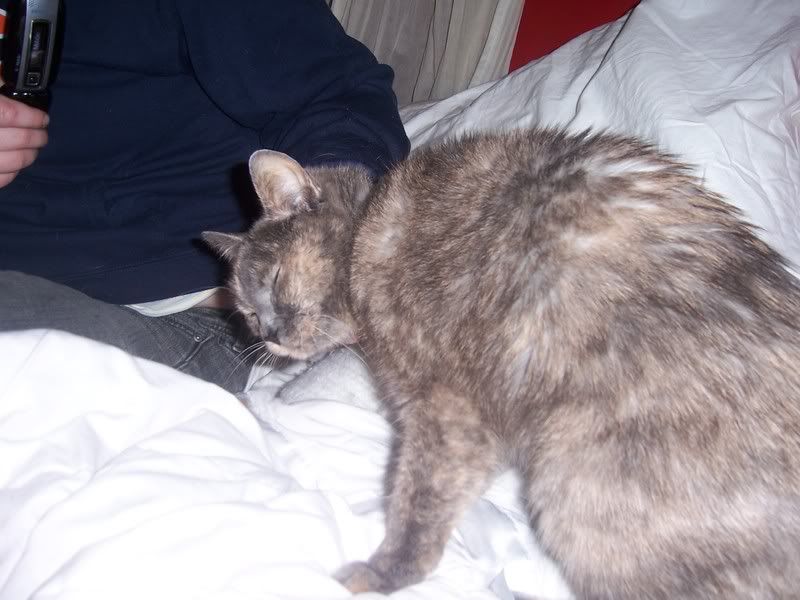 She loved to sit by the windows, where she could enjoy the sunlight and watch the birds. Once she got used to company, she liked to come up to people, sit nearby, and stick one of her paws out and rest it on the person’s hand. She would always sleep in someone’s bed, preferably with someone in it. She was quite noisy; she had a very loud rumbling purr and would greet people she liked with a sort of chirping sound.
She died too soon. On June 30th of 2008, a tumor that had been growing in her stomach suddenly burst. She had no chance of recovery, and she was put down the same day. It was very sudden; she continued on happily with her usual activities until the last few hours of her life. I’m grateful for that small mercy. She was a wonderful cat, and I was lucky to have her in my life for 8 years. The woman in charge of the cats at the shelter (I’ve always mentally referred to her as the “cat wrangler,” though sadly her real job title probably wasn’t as cool) said she had been neglected and possibly abused by her prior owners, so I guess I was able to give her something better than she would have had otherwise. I hope I did. She deserved it.
Via Grasping for the Wind, I came upon this interesting post by James Enge, in which Enge talks about the role played in each person by the “naïve reader” and the “sophisticated reader.” As Enge describes it:
The naive reader wants the hero to kill the bad guy and marry the space-princess (or space-prince, or what have you). The sophisticated reader is muttering, “Yes, this is much like the plot Burroughs used, with overtones of Hamlet and the occasional oblique reference to postmodernism which is de rigueur for self-consciously retrogenerical pastiche, n’est-ce pas?” The naive reader just wants to sit back and enjoy the movie. The sophisticated reader is the guy sitting in the row behind who won’t STFU.
Each person contains both. The naïve reader experiences the story directly- as Enge says, it is “the one for whom the reading experience is emotionally fulfilling.” The sophisticated reader, through deeper analysis and understanding of things beyond what’s up in the foreground, can augment the enjoyment of the naïve reader-or disrupt it, either by identifying issues the naïve reader would miss or running wild and nitpicking everything.
This made me think of a related question: What aspects of fiction are the primary sources of enjoyment, and what aspects are secondary or in the realm of peripheral details or nitpicking? These categories don’t correspond precisely to Enge’s casual and sophisticated reader, but they are somewhat related.
I think one of the biggest and most common barriers to understanding when considering fiction is the assumption that all fiction is ultimately about, or at least ought to be about, the same things, and that likewise all readers enjoy or ought to enjoy the same things. One of the distinguishing characteristics of science fiction, especially (but by no means exclusively) hard science fiction, is that it often moves issues of scientific and technical realism, along with things like creativity and logical consistency of background, from the peripheral/nitpicking realm to the foreground.
For me, and I think for many people who like science fiction (especially written), getting science and technology right isn’t just something that appeases my desire to nitpick or allows me to appreciate a story on an additional, supplementary level, it’s a source of pleasure in the same way that the plot and characters are. Background and setting are similar. I enjoy it when a setting is put together well, when the extrapolated social and technological effects of the science presented makes sense-and again, this is front and center in my mind in the same way that character and plot is. It’s primary, not supplementary. Fantasy often does something like this too, with J.R.R. Tolkien being the most obvious and striking example. This is quite different from most other forms of fiction, where the setting may have thematic relevance but is usually not an object of interest in itself. (Historical fiction is an exception, since the historical veracity of the setting is often a significant part of the reader's enjoyment. It would be interesting to know how much overlap there is between historical fiction readers and SF readers)
Indeed, some science fiction works more or less invert the normal hierarchy entirely, not only putting science, extrapolation of technology, and logical construction of setting up in front as sources of enjoyment, but pushing things that are conventionally considered the core of what good fiction should be about, such as characterization and prose style, into the background, or almost into oblivion altogether. If I’m reading a science fiction book with imaginative and well thought-out ideas, the quality of characterization often becomes a nitpicky background concern to me. A science fiction story is certainly not harmed by good characters, but often it isn’t much harmed by their absence either. A lot of the complaints about characterization in science fiction often strikes me as sort of like hearing someone complain that magical realist author Gabriel Garcia Marquez failed to explore the physical mechanism or social effects of the technology of the giant magnet that the gypsies had in One Hundred Years of Solitude, or about the improbable and melodramatic plots of many operas.
This is not an absolute rule, and it’s certainly possible to write science fiction that is primarily based on character or stylistic flair. There are plenty of character-based stories I like. I think my description captures the genre’s general thrust, however. This has serious implications for other issues, such as the desire of some people for science fiction and fantasy to gain greater respectability, but this post is long enough for now. I’d be interested in hearing how other readers experience science fiction, and if your take on the nature of the genre is similar to mine.
 Neal Asher has become one of my favorite authors as of late. This makes for some frustration when you’re living in the United States, where much of his work has not been published, making it necessary to either import or scour eBay and the like. (Aside from Asher and Stephen Baxter, I almost never import books- I’m too cheap, I prefer to buy domestic editions of books by foreign authors to encourage the publishers to bring more of their stuff to this country, and my vast backlog makes waiting for a domestic release basically a non-issue.) Fortunately, Night Shade Books has been bringing more of Asher’s work to the U.S., first with Prador Moon

Part of Neal Asher’s Polity future history (Gridlinked

What should have been a relatively simple assignment policing Hagren while its society is rebuilt and civic order restored becomes much more when treason is discovered amongst Cormac’s squad mates, and Cormac is chosen by his superiors for a hazardous mission to infiltrate a local separatist cell. This sets Cormac on a dangerous journey across the devastated former battlefields of the Prador War, pursuing humans as lethal and pitiless as the Prador themselves.
Interspersed throughout this story, Shadow of the Scorpion also tells of Cormac’s youth in the dark days of the war, and of the mysterious scorpion-shaped AI war drone that haunted his childhood- and that has seemingly reappeared.
I really liked this book. It provides plenty of the intense action Asher is known for, and continues to explore the setting of Asher’s future history. On a purely action/adventure level, the book definitely delivers, with Asher’s usual talent for excitement, description, and visceral power brought to the forefront. It also gave me what were probably the two things I most wanted from Asher: more information about the character Ian Cormac, and a closer look at the society of the Polity itself.
Most of the Polity universe books are set primarily on worlds outside the Polity, or on the Polity’s frontier, or on worlds suffering some crisis, and are shown mostly from the perspective of Earth Central Security personnel or people outside normal society. The flashback portions of The Shadow of the Scorpion gives us a nice look at Polity’s society on Earth itself, as experienced by average people. I love the world-building aspect of science fiction, so I enjoyed this a lot.
An important part of the flashbacks revolves around technology to edit or erase your own memories, sought by Cormac’s shell-shocked older brother after returning from a tour of duty as a field medic on the front lines of the Prador War. Quite plausibly, this is a much-sought service during the war, common enough to support the existence of large clinics dedicated to it, and Asher explores it well. The book chillingly juxtaposes the psychological devastation of war and the grotesque physical injuries wrought by Prador military technology, with the Polity’s enormously advanced medical science seeking to reassemble shattered minds with same casual efficiency with which it repairs broken bodies.
While there is still plenty of action, this is a more character-based story than is typical for Asher, and fortunately I think the characterization here is stronger than what I’ve seen from him previously. The portrayal of a newly recruited Ian Cormac several decades younger than the one we first met in Gridlinked is well done- Cormac is still recognizably Cormac, but he displays a previously unseen degree of emotional vulnerability befitting a man who has not yet become desensitized by decades of violence and horror.
The flashback sequences from Cormac’s childhood are also well-done. Asher’s portrayal of the young Cormac, a bright, introverted, precociously serious-minded child, rang very true to me. (There’s a brief line suggesting that Cormac has been diagnosed with mild autistic tendencies, and while it’s not the focus of the story, I think Asher’s portrayal is one of the more insightful and understanding fictional portraits of it that I’ve seen.)
The flashback scenes about Cormac’s older brother’s return from the war are also effective, and do a good job of portraying something often unexplored in stories of soldiers returning home. Mixed with the happiness of seeing your loved one safely home, there is the tension and awkwardness of reuniting with someone you care about who has been profoundly changed, the trepidation of wanting to reach out and reconnect with someone deeply marked by experiences you can never truly understand and not really knowing how. The portrayal of this is fairly subtle, yet to me unmistakable and quite poignant.
Shadow of the Scorpion
When not distracted by the laborious task of making my thrice-yearly posts to this blog, I also run the Space Opera group on Facebook. I'm proud to say that we just exceeded 200 members after being in operation for a little under a year. If you're on Facebook and you like science fiction, come check us out.

